The fastest way to look 5 pounds lighter and 10 years younger is to stand or sit up tall.
Standing posture
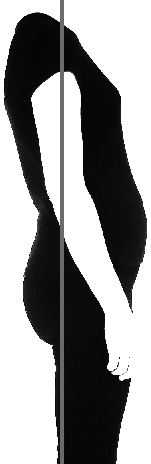
A common postural problem is "slouching" or "sway-back," which occurs when you allow your hips to drift forward. This position often causes you to lower your chest and bend your head and shoulders forward to maintain your balance. The resulting effect is that of a hunched back, drooping neck, sunken chest, and bulging belly.1 Your belly protrudes not only because it is pushed forward with your hips, but also because it is squeezed vertically between your hips and your lowered chest.
Letting your abdominal muscles relax too much may allow your pelvis to rotate forward, causing your lower back to curve excessively and your belly to protrude even more.
In proper standing posture, your chest is elevated, your shoulders are back and down in a relaxed manner (not rounded, hunched or pulled up), your jaw is level (not tilted up or down), your head is pulled back above your shoulders (not thrust forward), your hips are positioned directly under your shoulders (not slid forward), your belly is pulled in and up while maintaining a slight curve in your lower back, and your knees are not locked. If you were to look at a side view of yourself in a mirror, a straight line (such as a string with a weight tied to one end) dropped from your earlobe would pass over the center of your shoulder, the center of your hip, just behind your knee, and just in front of your ankle.
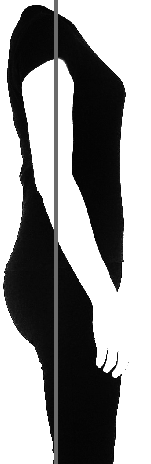 @ @
| ||
poor posture | perfect posture |
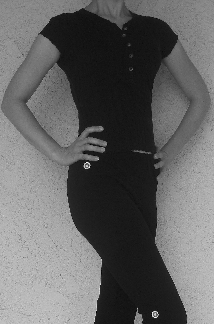
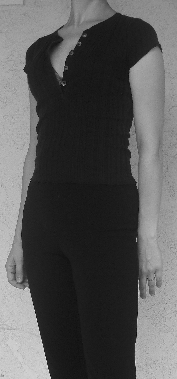
To test your hip placement and pelvic rotation, back up slowly to a wall. If your shoulders or upper back reach the wall before your buttocks, your hips are shifted too far forward. Now continue to back up slowly until your buttocks and upper back are both touching the wall. Try to slide your hand between the wall and your lower back. If it won't fit, your back is too flat, which means that your pelvis is rotated too far back. If you can fit both hands between your back and the wall, you may have too much curvature, which means that your pelvis is rotated too much forward. Try rotating your pelvis forward or backward until you have the right amount of curvature.
To correct a slouching posture, try these steps while looking at yourself sideways in a mirror:
This will all feel unnatural at first because your body has become accustomed to poor posture. With time your body will readjust to perfect posture and it will come to feel more natural.
With your body properly aligned, you should have lost at least an inch around your belly and gained about the same amount in height.
Sitting posture
"Slouching" while sitting can not only produce a hunch-backed and pot-bellied appearance at the time, but also cause muscle imbalances that contribute to faulty standing posture. Always sit tall, with your hips back against the back of your chair, a slight inward curve in your lower back (A rolled towel or lumbar support can help.), your chest elevated, your shoulders back and relaxed, your head held high, and your jaw level. Your hips and knees should be bent 90 degrees. Leave your legs uncrossed, or cross them at the ankles rather than at the knees. Crossing your legs at the knees removes the curve from your lower back, which prevents you from sitting quite as tall, and may lead to eventual back problems.
More tips
Here are some more tips that may help you in your quest for perfect posture: